
Jennifer Hamorsky, DDS, FAGD has been a dentist since 1995, and she took over this Carrollton practice in 2013. She’s a Fellow of the Academy of General Dentistry, which asks for 500 hours of continuing education, 350 of them live. It also takes a four-hour exam of 252 questions across all 17 dental disciplines. The Academy puts the number who hold it at about 6% of general dentists. None of that decides your case. It’s why All-on-4 vs dentures gets answered here from a scan rather than a preference.
What Each Option Actually Is
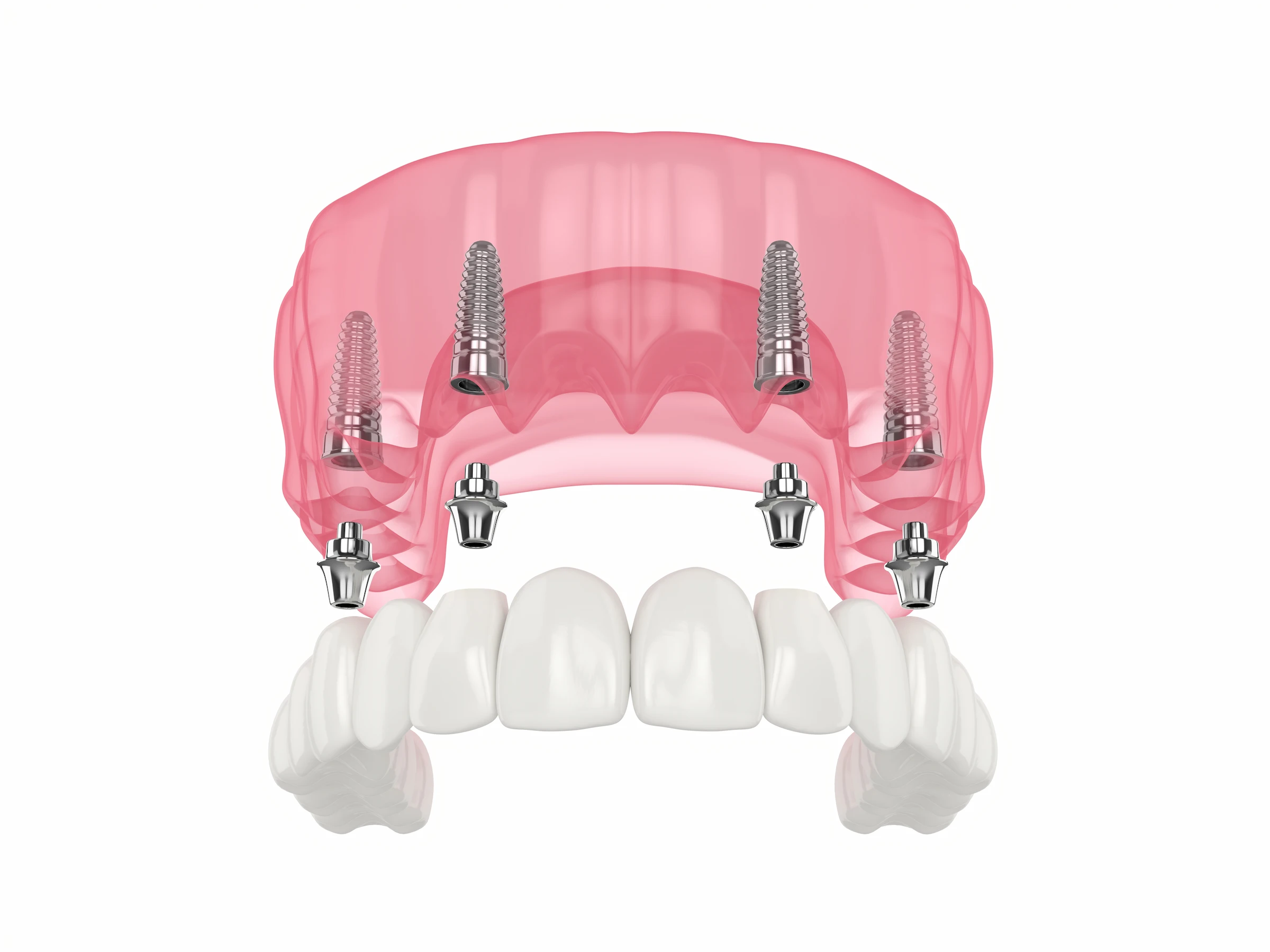
Start with the answer. Bone decides this more than taste does, and the rest follows from what the scan shows. All-on-4 is a fixed full arch, a whole upper or lower set of teeth screwed onto four implants and left in place. A removable denture is the one you take out. It rests on the gum and it’s held by suction, adhesive, or both. Between them sits the implant overdenture, a denture that clicks onto two or more implants and still lifts out for cleaning.
The three ask for different amounts of bone, different amounts of surgery, and different work from you afterward. An edentulous arch is a jaw with no teeth left in it. Any of the three can treat one, and the scan narrows the list.
How Much Bone You Have Left
Teeth hold bone in place. Take them out and the ridge underneath starts to shrink, which is ridge resorption, the slow loss of the bony shelf that held the roots. It moves fastest in the first year after extraction and doesn’t stop there.
CBCT 3-D imaging, a scan that shows the jaw in three dimensions rather than flat, turns that into numbers. Bone volume, meaning how much bony ridge is actually there, is what gets measured. Four implants need enough bone across the front of the jaw to anchor them, and the scan settles whether it’s there. Bone grafting can rebuild some of what’s gone. Upper cases sometimes need a sinus lift, which goes out on a referral to another office.
Losing every tooth is less common than it used to be. NIDCR reports that about 15% of adults 65 and over have no natural teeth left, down from 27.2% in the 1999 to 2004 survey period. Census QuickFacts puts 13.7% of Carrollton residents at 65 or older.
Fixed Teeth Versus Removable
The dividing line most people feel is a plain one: do the teeth come out at the sink, or do they stay in the mouth? A fixed arch is cleaned where it sits, with floss threaded underneath. A removable denture comes out, gets scrubbed over a basin, and goes back in.
Palate coverage is the plastic across the roof of the mouth that lets an upper denture hold suction. It also sits over taste buds. A fixed upper arch and an implant overdenture don’t need it.
Snap-in attachment systems sit in the middle. Two to four implants carry a housing, the denture clicks onto it, and it still lifts out. The attachment abutment is the connector between implant and denture. It wears down and gets replaced on a schedule, which is the line that shows up in the maintenance requirements.
What Daily Life Looks Like With Each
Chewing efficiency, meaning how much of a mouthful you actually break down before swallowing, is where the gap shows first. A fixed arch bites closer to natural teeth. A well-made removable denture handles bread and soft protein and argues with a rare steak. Eating and speaking both take practice, and speech settles before chewing does.
The ADA notes that follow-up visits after a denture is inserted are normal, so the fit can be checked and adjusted. Fit isn’t a one-time event with anything removable, because the ridge underneath keeps changing shape.
What Each One Asks of You Day to Day
- Cleaning time. A fixed arch gets threaded and irrigated underneath daily. A denture needs a brush and a basin.
- Overnight routine. Removable work comes out to rest the gum tissue. A fixed arch stays in.
- Food you can plan on. Firm and crisp foods separate a fixed arch from a suction-held denture.
- Adhesive. A conventional denture may need it. An overdenture usually doesn’t, and a fixed arch never does.
- Appointment load. Implant work runs across months and several long visits. A denture finishes in fewer.
- Repairs. Denture bases crack and teeth come loose. Both are fixable chairside or at a lab.
Cost and Longevity Compared
The cost drivers are the lines on the plan itself. One arch or both, whether bone grafting comes first, how many implants an arch carries, and the material of the finished bridge. A provisional set worn while you heal counts too. A conventional denture has fewer of those moving parts. The office accepts insurance and files for you, and CareCredit and Cherry are both on offer.
Prosthesis longevity means how long the man-made part lasts before it’s remade. How long implants stay in bone is a separate question. Cleveland Clinic puts the working life of an implant crown or bridge at around fifteen years, and a denture at seven years or more. Both of those figures assume the upkeep actually happens. Relines, new attachment housings, a night guard where grinding is part of the history, and hygiene visits.
The Teeth That Are Worth Keeping
Not every arch has to be cleared. Teeth with sound roots and treatable gums can anchor a bridge or hold a partial, and pulling them to simplify a plan can’t be undone. Treatment planning starts from the teeth that are staying. Where the bite has collapsed around them, full mouth reconstruction is what keeps them.
What You Can Check Before the Consultation
Every full arch option is a trade between how much bone you have and how much upkeep you’re willing to take on.
Some of this you can settle on your own. When the teeth came out, or when they’re coming out, starts the bone clock. Grinding belongs on the list too, because a fixed arch takes the same forces the natural teeth took.
Your medication list changes an implant plan more than most people expect. Bring it to the first appointment. Blood thinners change how implant surgery gets planned, and bone density medication does too.
Questions With Answers You Can Actually Get
- When did each tooth come out? The ridge starts shrinking the day a tooth leaves, so write down the years if you can.
- Where are the old x-rays? A previous office will release them, and they show what the bone was doing then.
- Do you grind or clench? A worn night guard or a cracked molar answers that faster than memory.
- What medication are you on? Blood thinners and bone density drugs both change the plan.
- Do you smoke? It affects how implant sites heal, and uncontrolled diabetes does the same.
- How many visits can you make? Count them against your work schedule first.
Bringing the Question to a Consultation
A candidacy assessment is the exam and imaging that settle what a mouth can actually carry. You can contact the Carrollton office to book one. Dr. Hamorsky, DDS, FAGD gives three options and a straight answer about each. Quality of life sits inside that answer. The CBCT shows how much bone stands across the front of the jaw and where the nerve runs. The exam reads the gums, the ridge shape, the teeth still standing and how the jaws meet. Between them they rule options in or out before anyone asks what you’d prefer.